
How It Works:Before the quarter begins, industry or academic sponsors provide a 1-2 page description of an engineering design project. This contains:
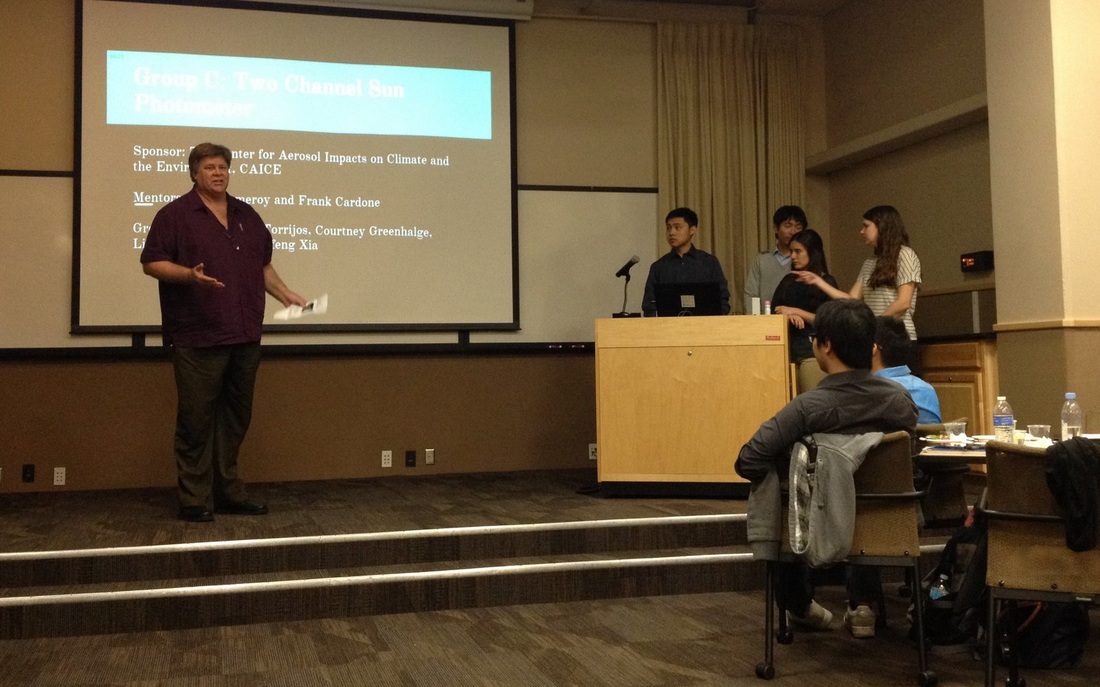
On the first day of class, a student group will be assigned to the project and will contact the mentor. Throughout the quarter, students work to design, build, and demonstrate the project, and document it along the way. Students have brief weekly discussions with the mentor on progress, and also present their progress in class weekly for feedback from the course faculty. At the end of the quarter, company sponsors are invited to the final presentation event, where students present their designs and demonstrate the projects. The projects are fully documented in a final written report. Costs: Industry sponsors pay for direct costs of the project (such as PCB fabrication), but all expenses are approved in writing by the industry sponsor before the expense is incurred. Direct costs are typically less than $750. In addition to the direct costs, companies are asked to support the ece 191 course with a $2000 donation per project, although this suggested donation is voluntary. IP rights: On the first day of class, the students sign over all intellectual property rights to the company sponsoring the project. Click here to see the form which students sign. |
What ECE 191 Is:ECE 191 is the Capstone Senior Design Project course within the Department of Electrical and Computer Engineering.
Groups of three to four students work for typically one quarter on a design project under the mentorship of an engineer from industry or a faculty adviser. Students design, build, demonstrate, and document an engineering project. 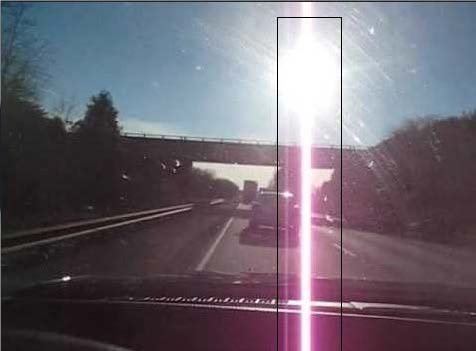
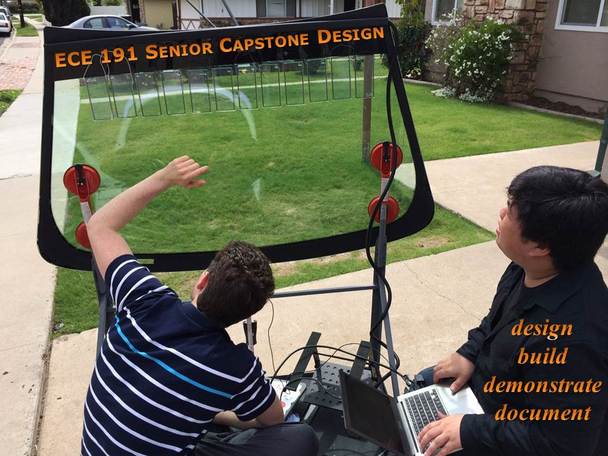
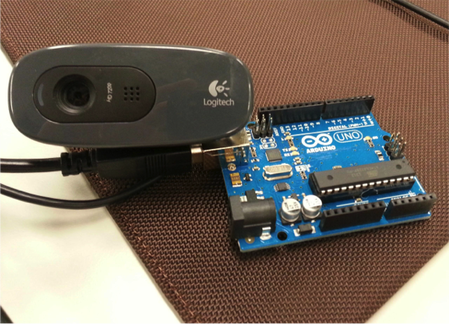
Project: Electrochromic Sun-tracking Sun Visor (pictures top left, above, and below).
|
|
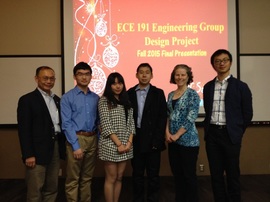
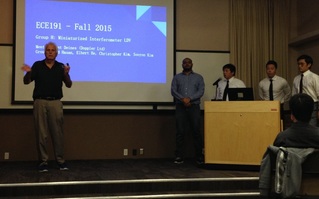
Fall 2015 Final Presentation
|
|
Success Stories for ECE 191 Students and Sponsors
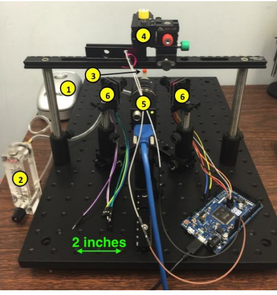
In Spring 2016, Allen Shi worked on the system for tracking and imaging freely walking fruit flies. The project required image processing and machine learning algorithms for auto focus. The project ended up getting some nice publicity in the New York Times:
www.nytimes.com/2016/06/06/science/creating-a-window-into-a-flys-brain.html and Allen got a job in machine learning with Bay Area Startup sensai. |
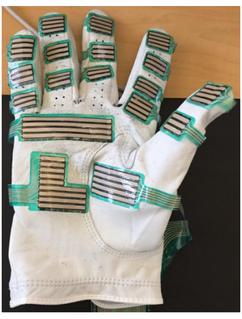
Several students have had 191 projects turn into Master's theses!
For example, one student as an undergraduate in Winter 2016 was on the project entitled "Wearable Devices for Improving Spasticity Assessment" and that set him on the path to an M.S. project. A year later his thesis was entitled "Validating Objective Metric for Improving Assessment of Spasticity" as he got his M.S. degree. |
|
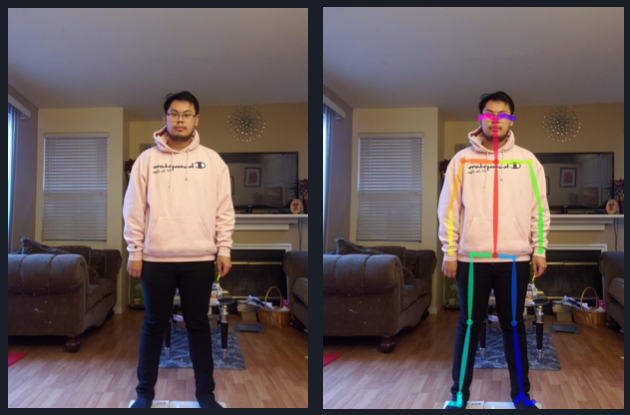
Rich Unite who worked on the machine learning side of the Balance Evaluation project (Fall 2020) got a full-time position as a SWE/MLOps engineer at Guild Education, based in part on his work in 191.
According to Rich: "During the interview, I mentioned that I was working with neural networks as part of my senior capstone project, and they were really interested in the applications of the neural networks in the project, as well as how I was gathering and using my data... some of their data is non-categorical, which really aligned with what I was doing with the joint angles and the balance. |
All five members of the Winter 2017 Gaze Glasses Team are co-authors on a journal paper!
L. Chukoskie, S. Guo, E. Ho, Y. Zhang, Q. Chen, V. Meng, J. Cao, N. Devgan, S. Wu, and P.C. Cosman, "Quantifying Gaze Behavior during Real World Interactions using Automated Object, Face, and Fixation Detection," IEEE Transactions on Cognitive and Developmental Systems, Vol. 10, Issue 4, pp.1143-1152, December 2018.
L. Chukoskie, S. Guo, E. Ho, Y. Zhang, Q. Chen, V. Meng, J. Cao, N. Devgan, S. Wu, and P.C. Cosman, "Quantifying Gaze Behavior during Real World Interactions using Automated Object, Face, and Fixation Detection," IEEE Transactions on Cognitive and Developmental Systems, Vol. 10, Issue 4, pp.1143-1152, December 2018.
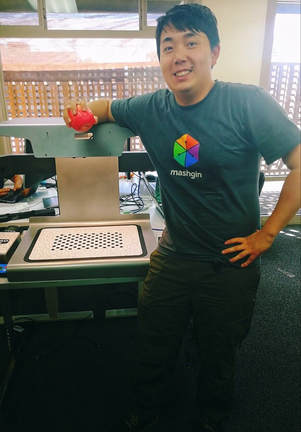
Shengyao Guo was a member of the Gaze Glasses Team in Winter 2017. His part of the project involved machine learning for project detection. When the quarter was over, he continued with the project for a whole year, ending up presenting a conference paper in Washington D.C. at ISBI 2018! His expertise with deep learning was crucial for landing him a job with NorCal start-up Mashgin, which builds machines for intelligent self-checkout for cafeterias, micro-markets and more with deep learning and real-time 3D technology. Here's a demo and photo of the product Yao is now working on: https://www.mashgin.com/index.html#demovideo
|
|
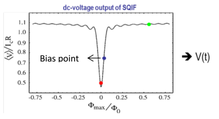
Shane Aldas was a member of the Spawar Team in Fall of 2017, working on designing a feedback control system for a Superconducting Quantum Interference Device (SQUID). Through his Spawar mentor, Shane got an engineering contractor position at a small startup named quinc.tech, working on superconducting magnetometers part-time while he finishes his degree.
|
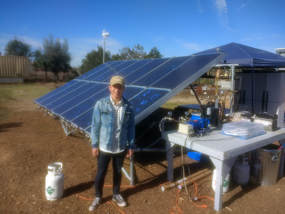
In Fall of 2017, Sung Ji Cho worked on the 191 solar panel cooling project called Icarus, sponsored by Retech Engineering. For Winter of 2018, he got an internship with Icarus! The photo shows Sung with the technology he helped develop.
|
|
Santos Alvarado was a student in ECE 191 Winter 2015, working on a portable solar power system for a trailer. Thanks to this project, after graduation he got a job at a photovoltaic company, Q Cells, in Irvine. |
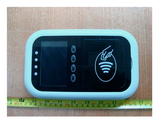
Leroy Kuybus took ECE 191 in Winter 2015, working on the Datalogger project sponsored by Cubic Transportation Systems. Leroy did an internship at Cubic over the summer of 2015 to finish up the project.
|
|
James Tang worked on the project Wireless Charging and Energy Harvesting for Wearable & Mobile Sensors in ECE 191, Fall 2014, sponsored by Electrozyme LLC. After graduating, he became a full-time hardware engineer with ViaSat, Inc., another one of our ECE 191 sponsors. |
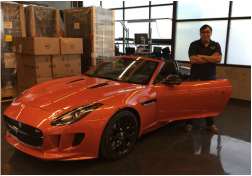
Anson Fan worked on the Jaguar Land Rover project in ECE 191 in Spring Quarter 2015, and now he's a Remote Vehicle Interaction (RVI) Developer for JLR. The RVI project group consists of software and hardware engineers working on open source code and hardware designs for connected vehicles. They hope to create a community to contribute source code/hardware design or the apps that live on top of this new ecosystem. Anson works on the data communication and big data aspects of the cars -- how to store and process all the data that cars produce, and how to extract benefit from these new wireless monitoring capabilities.
|
